Drone Crop Treatment: A Practical Look at Spraying and Spreading from Above
Why drone crop treatment is no longer a novelty
Walk a headland in early spring and you might hear it before you see it: the low, insect-like hum of an agricultural drone lifting off with a tank of fertiliser or a hopper of seed. A few years ago this was a demonstration piece, something to watch at a show. Now it is a working tool on UK farmland, and the question has shifted from "does it work?" to "where does it fit best?"
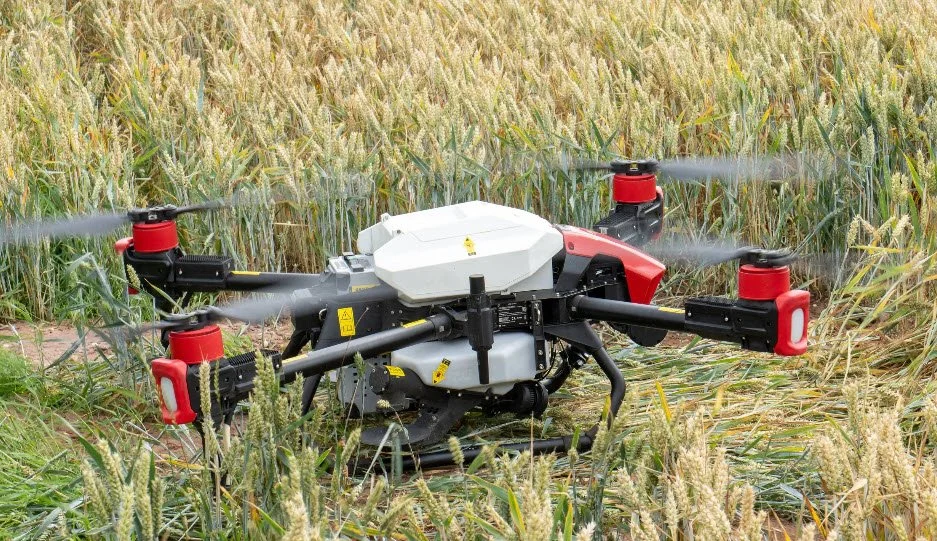
Drone crop treatment has matured into a genuine option for growers who need precision without the weight of heavy machinery. The DJI Agras series, in particular, has become a familiar sight, with its eight rotors and its ability to carry spray or spreader payloads across awkward fields. It is not a replacement for a tractor and a mounted sprayer in every situation. But it is a serious alternative for the jobs where timing, access, or accuracy matter most.
What drone crop treatment actually involves
At its core, drone crop treatment means using an unmanned aerial vehicle to apply something to a crop. That something is usually a pesticide, herbicide, fungicide, fertiliser, or seed. The drone flies low, often just two or three metres above the canopy, and releases its load through nozzles or a spinning spreader disc. The operator stands at the edge of the field, watching a screen that shows the flight path, the flow rate, and the exact area covered.
This is not remote-controlled guesswork. Modern agricultural drones use GPS, geospatial data, and pre-programmed flight plans. You map the field boundaries on a tablet, set the application rate, and the drone follows the lines. It turns itself at the edge, maintains a consistent height, and shuts off when it crosses a buffer zone. The result is a level of consistency that is hard to achieve by hand or even with a tractor in certain conditions.
The spraying side of things
Drone spraying is where the technology has made the biggest dent. For crops like cereals, oilseed rape, or pulses, there are moments when a foliar application needs to happen within a narrow weather window. Maybe the forecast shows rain in two days, and the fungicide has to go on before then. A tractor might struggle to get into the field if the ground is wet, or it might cause compaction that costs you later. A drone does not care about mud. It flies over the top, applies the product, and leaves the soil untouched.
There is also the question of spot treatment. Instead of blanketing a whole field with a herbicide, a drone can target patches of weeds that showed up in crop scouting images. This is variable rate application in its most practical form. You are not applying a uniform rate across the field; you are adjusting the rate based on what the crop actually needs. That saves money, reduces chemical load, and keeps the agronomy plan honest.
The spreading side of things
Spreading is slightly different. A DJI Agras with a spreader attachment can broadcast seed, fertiliser, or slug pellets with surprising evenness. Seed drilling with a drone is not going to replace a drill on large, flat arable fields, but it has carved out a niche. Think of overseeding a struggling grass ley, or stitching a cover crop into standing maize before harvest. Those are jobs where a tractor would damage the crop or the soil, and a drone can do it without a second thought.
Top dressing is another classic drone job. When a crop is showing early nitrogen deficiency, a quick top dressing of fertiliser can make a real difference. A drone can fly that job in a morning, even on a field that is too damp for wheels. The spreading pattern is consistent, and you can adjust the rate on the fly if you see a patch that needs more or less. That kind of responsiveness is hard to beat.
The practical advantages, and the trade-offs
The most obvious advantage is access. A drone can reach parts of a field that a tractor cannot, whether that is a steep bank, a wet corner, or a strip of land near a watercourse where you need to be careful with drift. It also removes the risk of soil compaction, which is a real cost on heavy land. And because the drone flies close to the crop, the droplets or granules land where they are meant to, not blown halfway to the next parish.
But there are trade-offs. A drone carries a smaller payload than a tractor sprayer, so a large field will take several tankfuls and multiple battery changes. That is fine for a 10-hectare block, less practical for a 100-hectare prairie. Battery life is improving, but it still limits how much you can do in a single flight. And the upfront cost of a quality agricultural drone, plus the training and certification, is not pocket change.
There is also the regulatory side. In the UK, the Civil Aviation Authority sets the rules for commercial drone operations. You need permission to fly beyond visual line of sight, and even within sight there are restrictions on height, distance, and proximity to people and property. A professional operator will have the right permissions and insurance, and they will know how to plan a flight that stays within the law. That is worth bearing in mind if you are thinking of doing it yourself.
Data, scouting, and the bigger picture
Drone crop treatment does not exist in isolation. It sits alongside crop scouting and yield mapping as part of a wider move toward precision agriculture. The same drone that applies a fungicide can carry a multispectral camera on a different flight, picking up stress in the crop before it is visible to the eye. That data, combined with geospatial data from soil maps and previous seasons, helps you decide where to apply what, and at what rate.
This is where agronomy comes in. A drone is not a decision-maker; it is a tool that executes a plan. The plan comes from scouting, soil analysis, and a good understanding of the crop's growth stage. Variable rate application only works if you have a reliable map of the variability. That might come from a drone survey, a satellite image, or a yield map from the last harvest. The drone then does what it does best: applies the right amount in the right place at the right time.
For many growers, the real value is the combination. You use the drone to scout, identify a problem area, and then treat that area with a targeted application. That is drone crop treatment in its fullest sense. It is not just about flying a sprayer; it is about using the data to make every pass count.
What the future holds for UK farmland
The adoption curve is still climbing. Early adopters were the innovators, the ones who liked new technology and had the budget to try it. Now the early majority is taking a closer look, especially on farms with mixed terrain or high-value crops like fruit, vines, and vegetables. The economics are getting better as battery life improves and prices come down, and the service sector is growing. You can now hire a drone operator for a one-off job, rather than buying your own, which lowers the barrier to entry.
There are also developments in swarm technology, where multiple drones work together to cover a field faster. That is still emerging, but it points to a future where drone crop treatment is not a niche tool but a standard part of the machinery line-up. For now, the practical answer is to match the tool to the job. If you have a field that is wet, awkward, or needs a precise spot application, a drone is hard to beat. If you have flat, dry, open land and a big sprayer, the tractor may still win on cost per hectare.
What is clear is that the technology has found its place. It is not a gimmick. It is a reliable, measurable way to apply crop protection products and nutrients with a level of accuracy that was hard to imagine a decade ago. And as more growers get comfortable with the idea, the question is not whether to use it, but where it fits best in your own rotation.
A final word on getting started
If you are considering drone crop treatment, start small. Pick a field that is awkward to reach with a tractor, or a crop that needs a timely application. Talk to a service provider who knows the local conditions and has the right permissions. Ask about their experience with the DJI Agras or similar platforms, and ask to see results from a similar job. The technology is proven, but the skill is in the planning.
And when you do run a drone pass, keep records. Note the date, the weather, the rate, and the flight path. That data becomes part of your field history, and it feeds into next season's decisions. Over time, you will build a picture of what works and what does not, and that is where the real value lies. Drone crop treatment is not a magic bullet, but it is a very good way to put the right input in the right place, without the weight of tradition holding you back.